(Machine translation by DeepL + adjustments by Gyegyopon, Translated article written for Japan without major changes, Sorry some Japanese language is still there)
Hello, this is Gyegyopon.
A total lunar eclipse will occur on March 3, 2026.
If the weather is clear, it will be visible across all of Japan under excellent viewing conditions.
This page summarizes the eclipse details and features photos from the previous lunar eclipse.
I hope this serves as a helpful reference for those planning to view the eclipse.
Main Text
Summary
A total lunar eclipse will occur on March 3, 2026.
Throughout Japan, the entire eclipse—from the start of the partial eclipse (when the Moon begins to darken) to the end of the partial eclipse (when the Moon finishes darkening)—will be visible.
The lunar eclipse begins early in the evening (18h49.8m) and ends before midnight (22h17.6m). Since the eclipse starts and ends at relatively early hours, it should be easy for many people to see.
The total eclipse phase lasts about one hour.
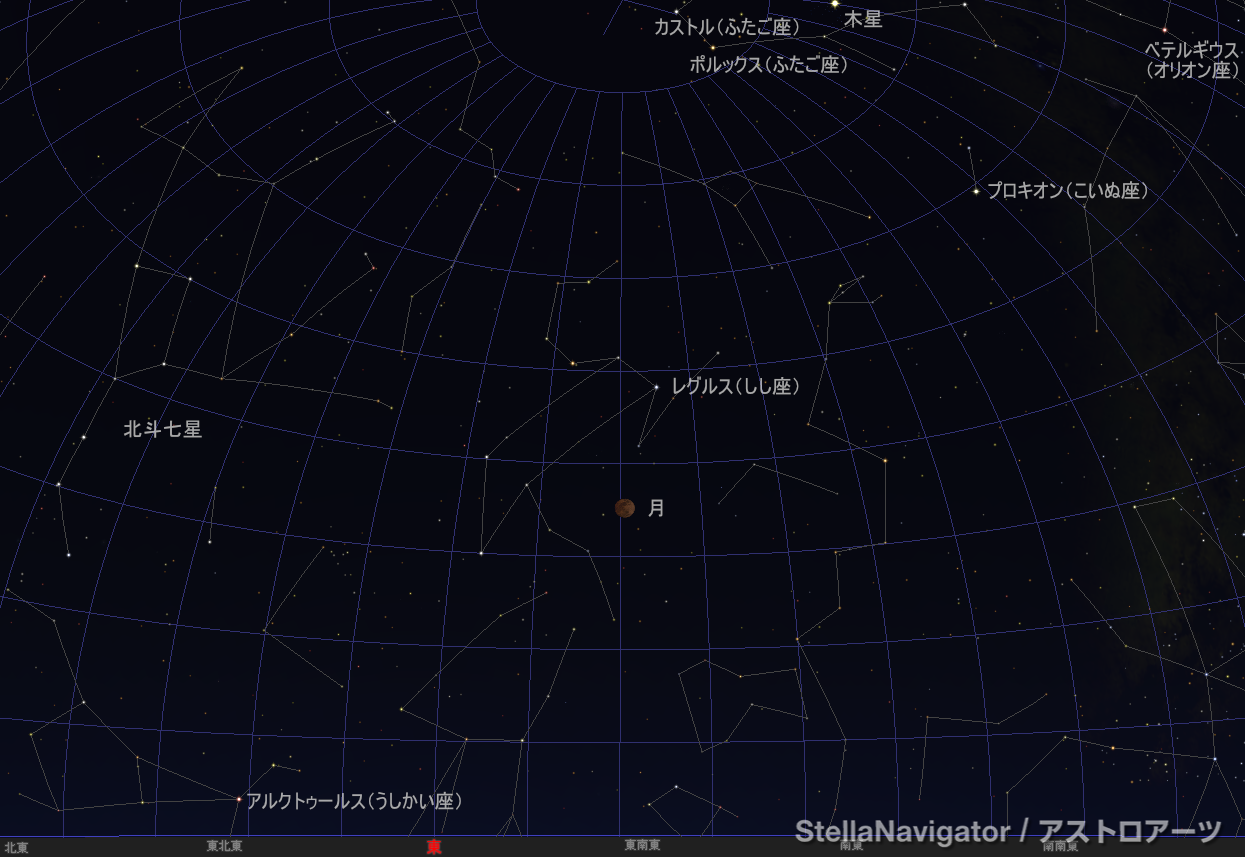
The Moon will begin to eclipse low in the eastern sky, move upward and to the right while entering totality, and finish eclipsing at a high position in the southeastern sky.

Shows the view from Tokyo. (The view from other locations in Japan will not differ significantly.)
The spacing between vertical and horizontal lines is 10 degrees1, with the top of the diagram representing the zenith (directly overhead). The Moon is depicted larger than its actual size.
Click to view a slightly larger image.
Created using AstroArts‘ astronomical simulation software “Stella Navigator”.
This total lunar eclipse will proceed as follows.
| Phases | Time |
|---|---|
| Start of penumbral eclipse | 17h42.8m |
| Start of partial eclipse (Start of Lunar Eclipse) | 18h49.8m |
| Start of total eclipse | 20h04.0m |
| Maximum eclipse2 | 20h33.7m |
| End of total eclipse | 21h03.4m |
| End of partial eclipse (End of lunar eclipse) | 22h17.6m |
| End of penumbral eclipse | 23h24.7m |
*The times for each phase will be the same regardless of location.
For explanations of terms, see “About Lunar Eclipses.”
Photos of the previous lunar eclipse
The last total lunar eclipse visible in Japan occurred on September 8, 2025. Please see the photos from that time.
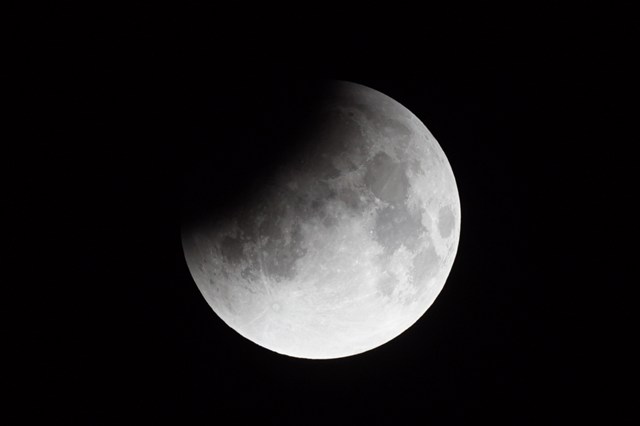
This is a photograph of the Moon during a partial eclipse. It was taken 33 minutes after the partial eclipse began.
The dark area in the upper left is the Earth’s umbra. The surrounding area appears dimly lit because it is within the penumbra.
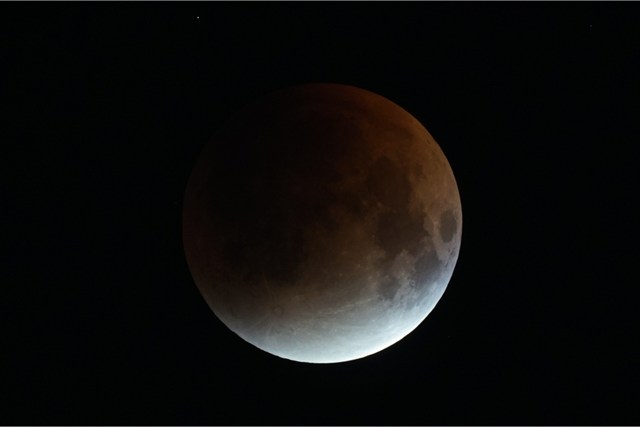
This is a photograph of the Moon just before total eclipse.
As the Moon’s light dimmed, the Earth’s shadow in the upper left began to appear reddish-copper in color3.
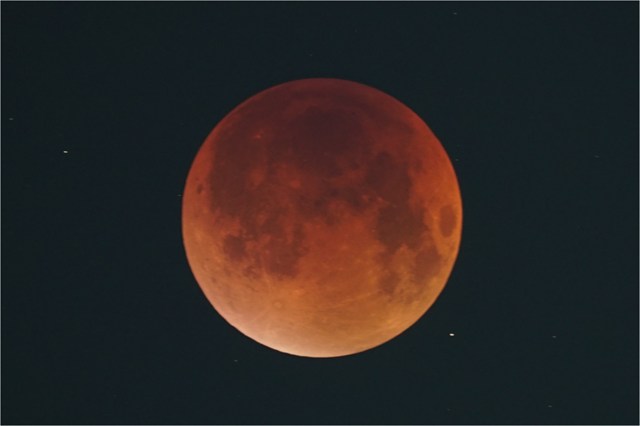
This is the Moon during totality.
The bright part4 disappears, and the entire surface turns a reddish-copper color5. The Moon’s dimness also made surrounding stars easier to see. (Several are visible in this photo.)
Surrounding stars
The full Moon emits an extremely bright light, so the surrounding stars are obscured by its glow and become difficult to see. However, during a total eclipse, the Moon’s light dims, allowing the surrounding stars to reveal themselves.
Why not enjoy the sight of a moonlit starry sky, a view you don’t get to see usually?
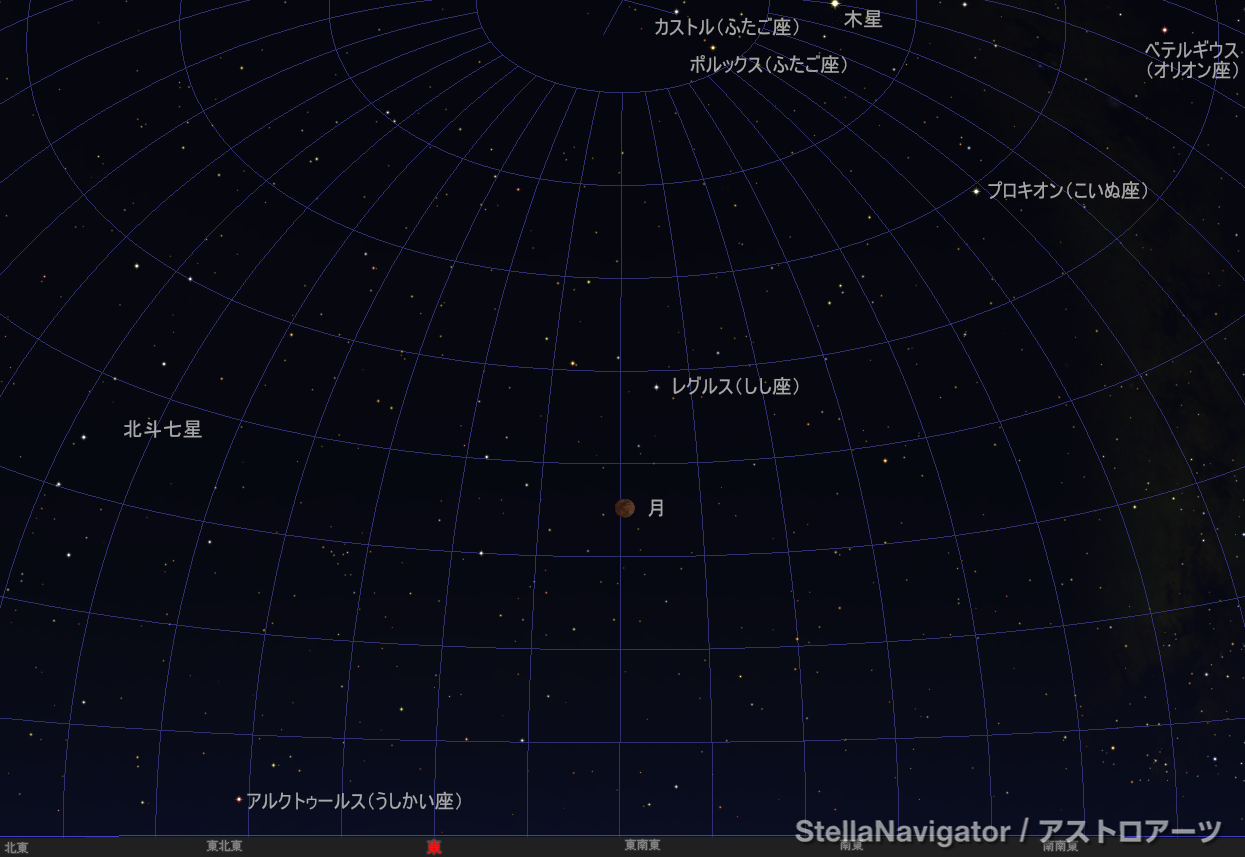
Shows the view from Tokyo. (The view from other locations in Japan will not differ significantly.)
The spacing between vertical and horizontal lines is 10 degrees6, with the top of the diagram representing the zenith (directly overhead). The Moon is depicted larger than its actual size.
Click to view a slightly larger image. A version with constellation lines is available here.
Created using AstroArts‘ astronomical simulation software “Stella Navigator”.
Why doesn’t every full moon result in a lunar eclipse?
The Moon orbits the Earth in about one month. When the Moon reaches the opposite side of the Earth from the Sun, it becomes illuminated from the front by the Sun, resulting in a “full moon” where the entire visible portion is brightly lit.
On the other hand, a lunar eclipse occurs when the Moon enters the Earth’s shadow, which extends in the opposite direction from the Sun.
If that were the case, you’d think a lunar eclipse would occur every full moon, but that’s not actually how it works. Why is that?
Actually, the Moon’s orbit is tilted about 5 degrees relative to Earth’s orbit. Because of this, even during a full moon, the Moon often passes north or south of Earth’s shadow and does not enter it. (In other words, during a full moon, when viewed from the direction where the Moon’s orbit appears circular, the Sun-Earth-Moon align in a straight line. However, when viewed from the side, they are not perfectly aligned.)
You might not quite grasp what that means. In that case, check out the video “Why Lunar Eclipses Still Occur” created by the National Astronomical Observatory of Japan. It explains things clearly using 3D animation. Be sure to read the “Public Relations Blog” post titled “A Total Lunar Eclipse Will Occur on March 3, 2026!” which includes this video. It’s interesting, featuring behind-the-scenes stories about the video production too7.
About Lunar Eclipses
What is a lunar eclipse?
A lunar eclipse occurs when the Moon enters the Earth’s shadow, causing it to appear partially obscured.
Though usually invisible as it stretches toward outer space, Earth does cast a shadow. It is sunlight that creates this shadow.
Types of lunar eclipses
“A total lunar eclipse” occurs when the Moon is completely immersed in Earth’s shadow at the point where it enters deepest into it.
“A partial lunar eclipse” occurs when only part of the Moon enters Earth’s shadow.
The Earth’s shadow consists of the “umbra,” where sunlight is completely blocked, and the “penumbra,” where some sunlight still reaches. The umbra is circular, with a diameter slightly less than three times that of the Moon. The penumbra has a diameter about five times that of the Moon and spreads out concentrically around the umbra.
In most cases, simply saying “shadow” refers to the umbra.
Sometimes the Moon does not even enter the umbra, but only enters the penumbra and ends there. This is called “a penumbral lunar eclipse”. Because the change in the Moon’s brightness is difficult to discern during a penumbral eclipse, it is often not counted as a lunar eclipse.
States during lunar eclipse
“Partial penumbral eclipse” occurs when part of the Moon enters (only) the penumbra.
“Partial eclipse” occurs when part of the Moon enters the umbra.
“Total eclipse” occurs when the entire Moon enters the umbra.
Eclipse magnitude
“Eclipse magnitude” is a numerical value indicating how much of the Moon is within the umbra.
With the Moon’s diameter set to 1, it represents as a decimal how much of the Moon is within the umbra. A larger number indicates a greater percentage of the Moon is obscured.
During a total eclipse, the eclipse magnitude value becomes 1 or greater.
Related information
For reference
Information referenced
- National Astronomical Observatory: Lunar Eclipse Forecasts by Location
(You can specify a location to calculate the direction and altitude of the Moon)
Related information
- This blog: I took photos of the total lunar eclipse
- National Astronomical Observatory of Japan:
- Why Lunar Eclipses Still Occur (Video)
- Public Relations Blog: A Total Lunar Eclipse Will Occur on March 3, 2026!
- Stargazing Information: Total Lunar Eclipse (March 2026)
- What is a Lunar Eclipse? (Explanation, Observation Methods, List of Lunar Eclipses, etc.)
Others
脚注
- The width of a fist held at arm’s length is approximately 10 degrees.
- the state where the Moon is most deeply immersed in the Earth’s umbra
- Even before this, the Earth’s shadow wasn’t pure black but reddish-copper; it was just difficult to see because the Moon’s bright areas were so luminous. Photographically speaking, if you exposed for the bright areas, the Earth’s shadow became severely underexposed and appeared black. Visually, the bright areas were dazzling, and the Earth’s shadow blended into that light, appearing black. Using binoculars or a telescope to magnify the view allows you to clearly see the color of the Earth’s shadow even before totality.
- the part directly illuminated by sunlight
- Light passing through Earth’s atmosphere is bent by the atmosphere, and furthermore, the blue light is scattered by the atmosphere, causing the light reaching the Moon to change to red. For an illustrated explanation, see “The Color of the Moon During Totality” in the National Astronomical Observatory of Japan’s “What is a Lunar Eclipse?”
- The width of a fist held at arm’s length is approximately 10 degrees.
- It’s just a personal opinion.